Letter to a Man I Never Knew

During those endless days of childhood, I often amused myself by reading whatever books I could find on my parents’ shelves. One slim volume was a witty compilation of rough line drawings and ruminations about the relationship between the name one is given at birth and the personality that follows — a rather adult and certainly abbreviated version of What to Name the Baby. Most of the details escape me now, but I did learn that almost any name bestowed upon an infant will invoke a future of ribald drunkenness, illiteracy, or a suspicious predilection for stray cats. Out of the entire book, I remember the succinct destiny for only one name. That name was John. “There’s nothing much wrong with any man named John.” High praise among a litany of very low expectations.

Every time I meet a man named John, I think of those words. I’ve never dated a John, never had a best friend named John, no teachers, no brothers or cousins; in fact, my life has been quite John-deprived. But there have been a few, and I always look at them a little differently than other random strangers who come into my life.

In junior high, back in the days when both morning and afternoon newspapers were the norm, our afternoon edition was dropped off by a cute blond boy named John Rendleman. If I happened to be outside, as I often was in the days when children weren’t allowed to lounge in front of the TV, John would always say hello to me as he passed. Not the hello of sneering girls or frogs-down-your-dress boys, but the kind of hello that made you feel like you were real, and he was real, and you were both going to be okay in the tumultuous world that began at the end of your front walk. There was no sizing me up to see if I was pretty enough, no checking the fickle list of popular kids, no shunning me because I liked school and did well, no rolling of the eyes because I was shy and probably never said a word in return. Just hello, and maybe a few words more — not a conversation, but simply an affirmation, an acceptance. At fourteen, that simple “hello” was a steady hand amid daily upheavals.

I don’t know what happened to John after junior high. Though we were almost neighbors, we attended the same school for only those middle years and never had a class together. Once high school began, I never saw him again. I don’t know who he loved, what he read, what roads he walked, or if he kept the bike with the banana seat. But I remembered his face . . . and his kindness.

About a year ago, an old acquaintance added me to a Facebook group: Myers Park High School 1973. I was flattered and happy to have the opportunity to learn what might be going on with classmates I hadn’t seen in . . . forty years . . .  and I didn’t have the heart to tell her that I didn’t even attend Myers Park, pulling out of public school at 15.

So I tentatively peeked in, still the shy bookwormy-type who never learned the art of small talk, wondering who I might find and if they’d be less scary at 50-ish than they were as a sea of restless 14-year-olds. And of course, who should I find there but John, quick to post about the celebrations, losses, and general welfare of those we’ve known, liking the posts of his fellow path-travelers, and responding readily with grace and the ever-present kindness. It felt good to get that glimpse again, the nod of affirmation, the steady hand. What I didn’t know was that he was taking the time to reach out day after day while being treated much less kindly by cancer.

John’s last post to the group was exactly a month ago. This morning, the same kind soul who invited me into the group let us know that John had died, and I can’t tell you how sad this makes me. Not because I never told him that his kind hellos had made me feel a little less alien at fourteen, because I have no doubt that he did the same for hundreds of others in his life, and I’m certain he knew well the value of kindness and the effect it had. And not even because I never really knew him — not in the I-can-list-the-name-of-your-children-and-pets sort of way — because the measure of a man goes beyond names. But I’m sad because there are only a certain number of people in the world, and that number is way too small, who can rise up beyond their own needs/fears/compulsions/frailties/distractions/insecurities/desires/apathy/navel and simply be kind. Day after day after day, to any person, anywhere, at any time.

In the end, of course, we never really know who we’ve touched, but those brief moments are so often our legacy.

So yes, that funny little book was right about Johns: there’s nothing much wrong with them. And sometimes, there’s a whole lot that’s right. And it doesn’t always take knowing someone to miss them. John Rendleman, I never really knew you, but I’ll never forget you.
And all of a Sudden . . .

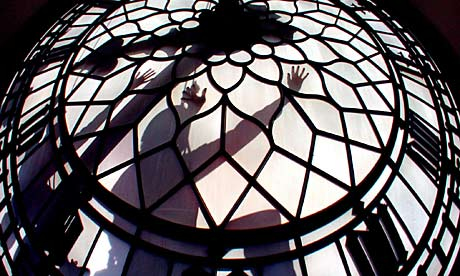
Big Ben by Martin Keene

the wait was over. It’s like the Limbo Dial spun itself silly and suddenly I was plunked down on the sidewalk, handed a quarter, and told to be on my merry way. And a merry way it shall be. But still . . .

I can’t help wondering who the timekeeper of this universe is. I can’t help wondering why forward motion stops with a jerk and leaves you dangling on the threshold of a leap. I can’t help wondering what lubricates the rusty key and gets the whole shebang moving again just as if you didn’t spend those months staring at days that crept by, eying you warily to make sure you stayed put, uninvolved, uninvited, fettered and quite inanimate. And most of all, I can’t help wondering why the wheel stops short for so many of us at almost the same exact moment in this anathema called TIME, and how it can be possible for the wheel to wind back up and heave forward in a single motion, the same single motion at the same single moment for those same ones of us again. And perhaps . . . I wonder . . . could groups of us be united not so much by common traits or experiences or hair color or literary loves, but simply because we’ve found ourselves on the same capricious wheel, whirring along at the same speed, sharing the same lulls, the same bumps, the same spurts? Could it be?

And so the wheel begins again and it’s almost as though it never stopped. Flurry replaces lethargy; the mind spins; feet become fleet; busy-ness soothes us and feels good. I don’t know what it meant — the waiting — but I’m glad it’s gone for a time. Godspeed.

I Like to Pretend

When do we lose interest in “let’s pretend?” When do we stop allowing ourselves to kerplunk right down in foreign scenarios, dreams, flights of fancy? I know the why (too many disappointments to risk one more), but when is the when? And (egads) why do we allow it?

I’m “away” for the weekend — my favorite place to be. It almost doesn’t even matter where “away” is — but as places go, this one tops many lists. I’m sipping tea on a deck with a rail made of handcut and hand-reassembled mountain laurel branches — a wood and air mosaic if you will. A bird visits for handouts. A mist rolls across the faces of my hosts: one, two, three, four, five, six, seven, is that an eighth? mountain ranges. Peace.

I like to pretend. What if I lived here? What would I hang on this wall, what mountain tomatoes would be the best to slice for lunch, which fruits in the feeder would bring the most colorful birds? And best of all, with ample time to look, what would I see in the faces of the mountain? What whispers would I hear in the night?

My life opens up when I pretend. I live in beautiful spaces, raw places, dine on the exotic or on the field greens I watched a woman in black gather from an empty lot in Greece. I imagine a new wardrobe: floaty and aqua near the sea, downy knits for the hills, pintucks in muted neutrals for France, accessorized by a long and skinny linen bread bag for markets.

But I can pretend just as well in my own backyard. I love to walk at night past the houses that look so alive, so exciting, with lights ablaze, the colors of various rooms leaping out (hello!), while I admire the addition of this or that piece of art. What if I lived here? Or there? Or, ooh! there!? Drop me down in a new surrounding and I fantasize: how would I be different?

Would the deep rose walls warm me? Would a daily infusion of Greek herbs clear my head? Would these blue mountains ground me, or would my spirit heal from the constant tumbling and resurgence of the sea? Am I fully a product of my current environment? 80 percent? 50 percent? How much of myself do I take with me from place to place, and how much of those places do I bring home?

Is there a dividing line between the life I lead and the life I dream, or do they commingle to make me whole?

The Summer We Waited

Waiting, c. Pamela Goode

Between the idea / And the reality / Between the motion / And the act / Falls the Shadow ~ T.S. Eliot

Am I going to fail my Zen test because I can’t love the shadow? I’m trying, really I am. I know good things will come, that fruition takes time, but . . . .  Good things come to he who waits is, I’m sorry, crap. Sitting around waiting never got anyone anywhere.  Good things come to those who DO.  But . . . do what? Where do you go when there’s nowhere to go?

I hate waiting. Of course this is a pointless comment — does anyone like waiting? Waiting eats our time, our patience, our resolve, our certainty, our energy. Waiting sucks, quite literally, and I am sucked out.

The spring seemed (was) rife with possibilities. I worked to schedule my time to accommodate them all, made lists and guides and proposals, gathered supplies and references, made contacts  and pursued leads. And then I moved on to take care of everything else — all the things that don’t wait while we’re waiting.

And it was good, but then . . . nothing.

Patience, patience, all good things take time. Deadlines pass. Excuses made. New deadlines created that will then pass and more waiting, more setting aside new chunks of more focused time to complete what you offered to committed to wanted to complete even though the game keeps changing. And the waiting gets a little less enchanting, a little less hopeful, a little less patient.

I fully believe that for change to occur, we must make the space for it. We must empty ourselves of pre-conceived ideas, old habits, tired ways, and the blindness born of always seeing things in the same fashion. But even being open to change isn’t enough — we have to empty the closets if we want change to stay for a while. But how long do you wait? How long to you wait and believe, with that damn shadow pulling out every sneaky trick in the book to become your new best friend? At what point will I morph from the being-who-welcomes-my-full-destiny to the-lady-with-so-much-time-that-she’s-making-macaroni-mosaics?

Too-abundant and so-rarely-productive surplus of time, I hate you. I want to love you, but I don’t. I want what I’ve worked for, and I want it now. Or even tomorrow, but I’ve had it up to here with this flapping in the breeze.

It’s a funny thing about waiting. Funny in that f***you sort of way. Because in the interim, time does what times does best: it changes us. Not the change we planned for hoped for made space for welcomed, but in some Other way, a way that’s a bit harder to pinpoint, speaking with a softer voice and holding out a very blurry map, but helping herself to my closet space nonetheless.

*This is not the post I meant to write, but this is the post that came out. I meant to point you toward my two newest blogs (that’s what too much time will get you): Wild Hair Adventures, a compilation of my travel essays and photographs (toddler stage), and Ormolulu, a blog to celebrate junking excursions (still quite an infant). Hope you like.

rewrite

the world is topsy turvy on me now
and i am left to wonder
if my center is askew
or simply old
and hardened,
and seeing these new days with eyes
unable or unwilling
to adjust
from my accustomed way
of watching doing caring.
asking soft if i will need to (want to) (or be able to)
re-right (rewrite)
myself ,
or if the universe
will find her quiet balance
now
at last.
or maybe
we will both fly off our axes
toward
the twinkly
stars.