Why I Make Mosaics

Photo by Ashley Hayward

A young man came into the gallery one day and, like many, stood with his mouth agape staring at the art on the walls. “What is this?” he asked. “It’s mosaic!” I answered with a smile. “Well how do you make it? Where do you get all these little pieces of glass?” “We cut them,” I said with a little glow. “Cut them? You mean you have to cut every one of these pieces?” “Yes,” I said. “Every piece.” “Oh man,” he said. “Why would anyone do this? There’s got to be a way to streamline this process. Somebody needs to sell the glass already cut. Doesn’t anyone sell pre-cut glass?” “Well, possibly,” I said, “but then I wouldn’t be interested.”

And there you have the answer in a  nutshell. I make mosaics because it’s hard.

During the monthly and often weekly classes I teach, new students will often take on a familiar stricken look when they first start cutting. I tell them to relax and cut for the pleasure of exploration — that making mosaics means learning the love to process. And the process is hard.

Some might say I like a hard life in general. I’m a good one for trudging through the minutiae of a situation, considering every possibility, and then selecting the most time and soul-consuming avenue. To me, this simply equates to actually living my life rather than just going through the motions. It’s the same way with cooking, planning, picking out (and decorating) a Christmas tree, traveling, thinking, loving, and art. Either I do it to the max, or I don’t do it at all. Otherwise, what have I gained? What have I given?

I love mosaic art. I love the interplay of color. I love the dancing of light. I love the intention of andamento and the way it makes your eyes move. I love the heft of a piece, and not only the weight of its gathered materials, but the sum of thought and labor involved. I love the antiquity of the artform and the accumulated labor of so many who have labored before me. But most of all, I like the slow, intentional, repetitive, considered and exacted repetition and thrill of determining the perfect cut, achieving it, and fitting it into place to create, many hours and days and weeks and sometimes months later, a piece of art that demanded and received my full attention — my full passion.

One of my favorite mantras is from the movie “A League of their Own,” when Gina Davis admits that something is hard. Tom Hanks (isn’t it always Tom Hanks?) says “Of course it’s hard. If it was easy, everyone would do it. The Hard is what makes it Good.” He’s so right.

It’s a funny thing about “easy.” There are many things that I do because they are “easy” for me, like sorting or folding laundry or unloading the dishwasher or writing a press release — I can have them done in the time it takes to think “oh — I should do this.” Accomplishment is a powerful feel-good, and we can rack up way more of the easies than the hards. But does that make them good? Well, no. None of my easies will ever make it to my Very Favorite Things list.

But give me something hard: determining and creating the ideal ratio of perfect cuts to “human touch” in art, cooking the (very) occasional meal that takes alllllllll day, raising a child, or growing the balls to be my fullest self, and I’m all over it.

So yeah. I love mosaic because it’s damn hard. I think we all need to love and engage in something that tests us, that pushes us flat up against the wall and says, “Do your best. Now.” What tests you? And what do you love about it?

Past, Present, Future (with Sun, Sand and Bracelets)

I’ve never been called the adventurous type, and I have to admit that social gatherings scare me. I should drink more, but what can I say? I’m a lightweight. I suck at keeping up with people, and that includes the people I love most as well as those I’ve loved the longest. I’ll spare you my soul searching on that one, and only share that this past weekend, a lovely spontaneous possibility presented itself, and I didn’t say no.

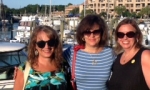
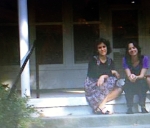
Instead, I settled into a glorious reunion with my two best girls from college, neither of whom I’ve seen in something approaching thirty (!) years. The wait was way too long, but, you know . . . best laid plans . . . life intervenes.

Nature Boy ElliotI spent some time on the ride home wondering about the nature of friendship. I met Jeanne and Carol pretty much by chance and proximity. We shared a dorm, a hall, and adjacent rooms. That could have been our only bond, but it wasn’t. Out of 5,000 undergrads, they remained my closest friends throughout those years. Away from home for the first time and wading our way through growing up, it worked. But what about now? We’ve never spoken on the phone, and letters and emails have been sporadic. In fact, it took another friend to get these balls rolling again for three introverted girls.  Nature-Boy Elliot made sure we found each other again.

And here’s what I’ve learned. Life is often scarier than you anticipated, but friends still help you through. Was our friendship chance? I don’t think so. Would we still be friends if we met today? Absolutely.

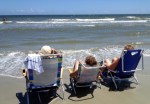
What did we do? We ate, we explored, we watched the waves and got a bit sunburned, we ate more, laughed more, learned more. We posed in front of the camera for Jeanne’s SuperHost Husband Rick. What did we talk about? Exactly what we always talked about: life, family, love, ups, downs, figuring-it-all-out, and a bit of nonsense. And we did what women do best — we reaffirmed. And so I emerged on the other side of the weekend a little browner, a little more relaxed, a little happier, a little more loved, and a lot more anxious to stay in touch with those who have helped make me who I am. I miss our abundance of innocence and idealism sometimes, but we still pretty damn well rock it.

xxooxx

She’s Not Here

Photo and Sculpture by Micheal Pardue

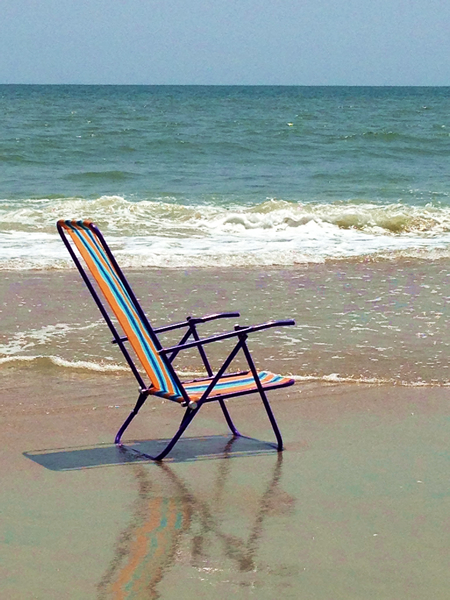
On the beach and far from phones and computers, my thoughts turn like homing pigeons to laundry lists of tasks both real and imagined, and I wonder peevishly how long it will be so. How long before the wind shakes me silly and the sun evaporates every drop of logic until my cranium is hollow, bone dry and thirsty for folly and impulse?

The ocean is tricolor today: aqua near the sand, then teal, with a thin navy stripe that hugs the horizon. How do I move from the frothy edges to the navy depths? Why am I stuck in minutiae?

I’m willing to wait, but I’m anxious. Maybe eager is the better word, but anxiety lurks. I love the deep. I live for the deep as much as life allows, and in this instant when life is handing me an unexpected gift of time and sand and sea, I struggle to be here now.

If I tilt my head just so, I feel the heat of the sun on my left cheek and a sea-cooled breeze against my right, and it charms me to learn that two divergent climates can co-exist on my one small head. I think two lives are spent here as well.

In truth, the voice that pulls at me is not minutiae, and therein lies the rub.

I could stretch myself flat in the sun by the sea quite joyously for every day of the years I have left, until my brain is so bereft of new stimuli that I begin to grow worlds in its place, and I sometimes wonder if that is precisely the life I was made for. Egos crushed like periwinkle shells into smears of yellow or purple against the sand, hair blown wild into a wooly nest for puffins, with skin the color of night, the texture of winds, quite pockmarked with stars and story.

Instead, the sun teases the too-well-known out of us for only moments at a time, until some trivial matter demands our attention and we leap, almost grateful for permission to return to the safety of the familiar, that easy cloak (tired, worn) that fits so effortlessly even though we meant to trade up so many resolutions ago.

The truth is that I’m experiencing a major life-shift, and I don’t yet understand how to walk it. Given the hours to stare into nothingness, understanding will come, but the days that have filled and will fill out this year have not been slated for me; my diligent attention is called for elsewhere and I am honored to give it. One day there will be time and presence to spare, and I will surely miss today. And so for now, I’ll try to make peace with not letting go.

What Are You Waiting For Blog

Know Thy Selves

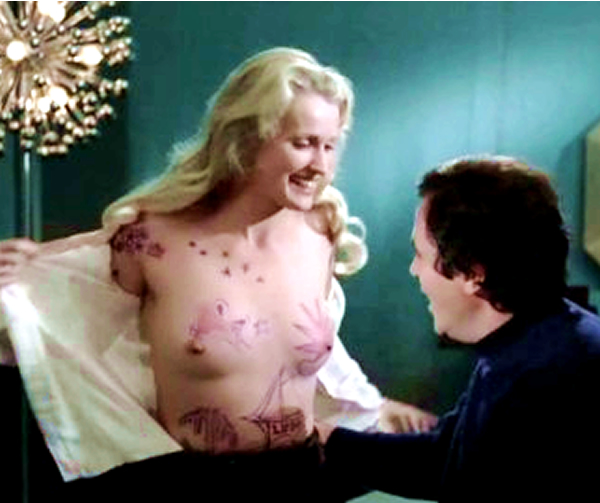
Our Bodies, Our SelvesRemember when it was all the rage to sit on the floor of the campus gym sans pants, whip out your compact, and examine your vagina? No weewees, no woohoos, no girliebits; we were hot to call a vagina a vagina, and we were determined to get up close and personal enough to be on a first name basis. Our Bodies, Our Selves was the handbook, although I seem to remember the 70’s bearing a rather unbalanced focus on the Bodies half of the equation. Frankly, it was a whole lot easier to find a group of women ready to shed their clothes for Enlightenment than to find one who actually carried (or owned) an actual compact. Makeup was for sissy girls.

Women 1970's via ourbodiesourselves.orgWe were a Gung Ho sort, and even if we read our Sartre naked in the bathtub with a guy we’d met at the falafel house only an hour earlier, we were hungry to know it all, do it all, feel it all, read it all, live it all, conquer it all, save the world, free women from centuries of silence, get it out there, and live it real. We were ready and primed to Make Life Our Bitch. We all looked like Ali McGraw, and we were determined to be taken as seriously as Gloria Steinem. We brought womanhood, for a time, from darkness into light, and it all started with a fierce determination to know ourselves, vaginas and all.

When did we lose touch?

A year ago today I sat in my kitchen with a close friend that I see only twice a year. She was waiting for test results from a biopsy, which would be positive. I had cancer too but didn’t know it — didn’t suspect — and wouldn’t until much later that spring. When did we move from living our lives armed with mirrors and books and knowledge and experimentation to living our lives with long and mostly irrelevant To Do lists, blindfolded against our innermost secrets? When did answers become written in water, and taking care of Our Selves become a second fiddle melody? When did we move from Knowing to Not Knowing, because Knowing has become so damn hard?

Contrary to popular belief, Our Bodies Our Selves was not about sexual liberation, even though most of us seemed to read it that way. In fact, it was about women learning to care for their own health. Forty-ish years later, we pretty much take care of others instead.

We march; we speak out; we advocate for free mammograms; we rally; we sit with each other and shave our heads in sisterhood; we refuse to be talked down to; we have each other’s backs. But we still never quite know what’s inside us at any given moment — a sobering reminder to seize the day.

Cousin Cousine 1975In many ways, 18 was bliss, wasn’t it? Knowing our bodies was largely a pursuit of pleasure: learning to kiss, trying exotic new tastes from multicultural gems near college campuses, teaching our muscles to scale mountains on weekends with adventurous new friends, getting silly with markers or grimacing under tattoo needles. At 56, knowing my body means something else entirely, and mostly what it means is discovering how much of what I’ve learned to love is now on the list of things that I’m forced to un-love (exotic tastes and climbing mountains high on the list). Making peace with the woohoo was a hell of a lot easier than making peace with organs that mutate in silence, and oh, how much more fun!

And so these later days reprise that urge to know, deep down; to feel, deep down; to live, deep down. If there is no magic mirror to show me what monsters lurk inside or to predict which cures will simply kill me another way on another day, I need to be in tune enough with my spirit to hear the longings of the body I yearn to heal: feed me; love me; take me out dancing; sing me a song; let me spend the afternoon painting my body with daisies and then giggle loud and long enough to wake the neighbors; or linger in a field of wildflowers way past time for dinner. Feed me a daily moment of bliss. Or three.

P.S. Dedicated to Carol, Susan, the MoHos, Jeanne Beanie, Carol H, the Duke Forestry School, my Love, my family

Elephants and Ladders

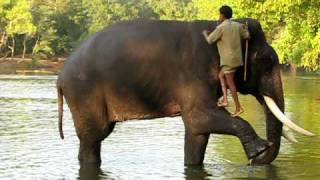
Elephant and Elephant-Made Ladder, by PrajaktaPradhanAnd just like that, seven weeks have passed. Seven weeks that began as One, stumpingly segued to Four-and-a-Half, and curiously culminated as Seven-that-Felt-Like-Four. Tomorrow, Friday, October 12, marks my last day of radiation, and Saturday, 10/13 will be my first day without it. Again with the Lucky Number.

On my first radiation center visit, I argued with my husband in the car on the drive over and cried the rest of the way, then spent 45 minutes lying alone in a room on a CT table thinking about this: every day for the next seven weeks, I will be forced to wake up in the morning, acknowledge that I have cancer, and drive myself nine minutes down the road for treatment from strangers. The radiation part? No biggie. The acknowledgement part? Biggie.

And so it went that I drove myself alone for the first treatment on the first day and put myself in the hands of four strangers in gray scrubs who would become my morning companions for the next seven weeks of my life. I can’t tell you how much I’m going to miss them.

Years ago, after a particularly shaking experience with someone I cared about, I headed out the door for a walk. I was in a strange city and knew no one, with a map folded into my back pocket. After about 45 minutes of emotions-in-a-twist-staring-at-the-pavement under my mindlessly-moving feet, I looked up and across the narrow road straight into a tea room with its doors flung open to the day. Inside, a woman paused, looked out, and smiled at me. I smiled back. And in that instant, that moment-with-a-stranger, I was fine.

And this has been much like that.

I’ve always been fascinated by the connections we form in life. Some of the people I remember most vividly are those with whom I’ve spent the least time, but with the most intensity. Some taught me life lessons, some gave me a nudge back onto the path, others showed me new ways of being, some simply showed compassion — but almost consistently without a surplus of words — and often with no words at all. And then they were gone — but only — only — in a physical way. Those that impact us in times of need are with us forever.

And I think about this: it’s so easy to be kind. It’s so easy to give a nod, a smile, a touch. I count myself at the top of the list for too often being too afraid, too shy, too sure my words are cheesy or my interest suspect, and I need to change that.

And so to Rick, whose curls bounce every morning when he nods and his eyes twinkle hello: Thank You. To James, who fetched me gently from the waiting room alone on that first day and always tries to make me laugh: Thank You. To Betty, whose mega-watt smile and cheeriness always calm me: Thank You. To Will, who didn’t flinch when I sulked up to him on Day 1 and put my hand on his chest to turn over his name tag because I didn’t want to be treated by a man whose name I didn’t know, and who looked in my eyes to keep me steady: Thank You.

Thank you all for bringing me from this to this to this.

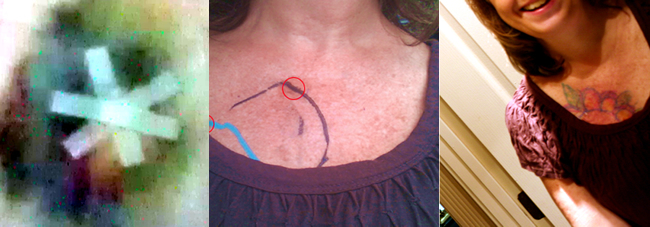
Breast Cancer Biopsy, Radiation Registration Lines, Almost Done Breast Cancer Biopsy Bruise, Radiation Registration Lines, Almost Done

Oh! The title for this post was provided by my daughter, of Ashinine, quite randomly, with no knowledge of the post content. Ever a lover of Metaphors for Life, I’ll give you this: We are all at times large and clumsy, unaccustomed and often ill-equipped and, certainly in my case, articulate only in an alien-ish sort of way when we encounter the unexpected. Thank You All for being the Ladder to my Elephant, giving me something and often someone to hold on to, a leg up, access to a broader view, and a steady hand. I’ll never forget. Hugs and Kisses.

Presbyterian Radiation Oncology

Is Change a 4-Letter Word?

I’m sitting at the new desk my son and I made over the weekend (“Mom, you need a desk. You can’t keep working in the kitchen.”), which means that instead of watching the Southern light stream in just above the row of Italian cypress that Sweetest and I are patiently watching inch up toward the sky, I’m gazing over the Northern vista toward the English garden he designed and planted surrounding a stately and spreading elm.

Tree HaulOr, more precisely, I’m watching a trampling of the English garden as five neon-yellow-chested workers carry the centerpiece off in huge slices hoisted on their shoulders.

We knew she was on her last leg when we moved here, but despite the hollow cubbies here and there and the massive cable linking her three largest branches, still she stood, day after day, happy to hold a swing and a bee skep, willing to shade the hostas and hydrangeas that wouldn’t survive without her leafy sun-shield. Our Tree Guy said, “She’s gonna hit the ground one day, but she won’t come near the house, so I’d leave her up as long as she wants to stay.” And so we did, hoping that would be Forever.

TreefallForever came this weekend. Vernon heard the crack as one of the cables snapped and a third of the trunk broke away, filling the yard with branches fifteen feet above the ground. When Jason and I returned from Desk Materials Central, aka IKEA, we drove right into that dead-tree-jungle of twigs, branches, leaves, and barkness everywhere. Oh. Welcome Home, Change.

Tree Garden 2012And so my new work vista that would have looked like this:

Tree Garden 2012 After

now looks like this:

There are worse places to be, of course.

When I get pissy about this or that, I try to fall back on the mantra: Embrace Change, Embrace Change. And still I wonder, my mental rambling accompanied by the harbinger chant of a chainsaw, where’s the upside here? Change, I’m not a total hardass. Show me the upside and I will meet you halfway. Maybe a nod today; maybe a handshake in a couple of weeks.

So far, no response, just a peculiar morning watching the yellow guys pulling elm branches out of the fifty-foot redwoods, and it’s all very Magritte. I need tea.

Magritte, Carte Blanche

Life: Not for the Squeamish

Tiny Flower, Pam Goode

Tiny Flower, Parking Lot, Presbyterian Cancer Center

I walk into my second radiation treatment behind a woman in a fun skirt made of vintage tablecloths, her round head sporting the new growth that looks like peach fuzz. An attendant in an orange shirt helps a blanket-wrapped man from the wheelchair into a waiting car. I see two other patients, both with walkers. The youth of my radiation techs looks good to me now, and the way Amanda’s face lights up when I finally notice she is pregnant and ask about the baby makes my morning. Outside of Amanda and maybe the cute young tech, I look to be the healthiest one here. I feel the need to help carry those who are dealing with so much more than I am, but it isn’t time — I don’t want to infringe.

They say radiation is a breeze, and so far it is, as long as you don’t stop to consider the deadly rays funneled into your body daily — those very rays we’re taught to fear and work to avoid. And as long as you don’t look around too much at the others sharing your journey.

Over the past few weeks, waiting for this day, I’ve dreaded the start of radiation because to me it meant this: thinking about cancer for an hour out of every 24 for seven weeks. Now, I know that it will mean this: hurting for every person I see here daily, and understanding that pretty much every one of them is facing a mountain far higher than mine. I am so lucky. Why?

I hope this is the only time in my life that I’m given free and preferred parking. The woman who chose the space next to me sat in a battered once-red car with her hand to her head and the windows down. She didn’t look up when I eased into my car. It was 10:13. Of course it was — it’s my lucky number.

Cancer is not the hardest time I’ve faced. Watching my mother die and trying to steady my father each day as his mind fades top the list. Dealing with pain I’ve caused others is a close second. These passages are agonies. Cancer is a wrench in your life-clock, a rewriting of plans, an upending and introspective re-centering. In a way, it is death and rebirth without the dying.

I don’t know why I have cancer, and I don’t know what cancer wants from me. I know we don’t need more suffering; we are overrun with suffering. Maybe we simply need another voice. Do we? With cancer claiming an ever-increasing percentage of the population, surely the numbers begin to blur. But I can be a voice. I can see beauty and celebrate with awe and I can create, after a fashion. This daily dose of hard-awareness will fuel me, once I release my grip on the melancholia of it all.

We are born into this life fairly fearless, but our willingness to grasp the new is fleeting. More and more I realize that fearlessness only returns to us after we open our eyes and drink in the realities, both good and bad, that surround us. Awareness and action: my two new friends.